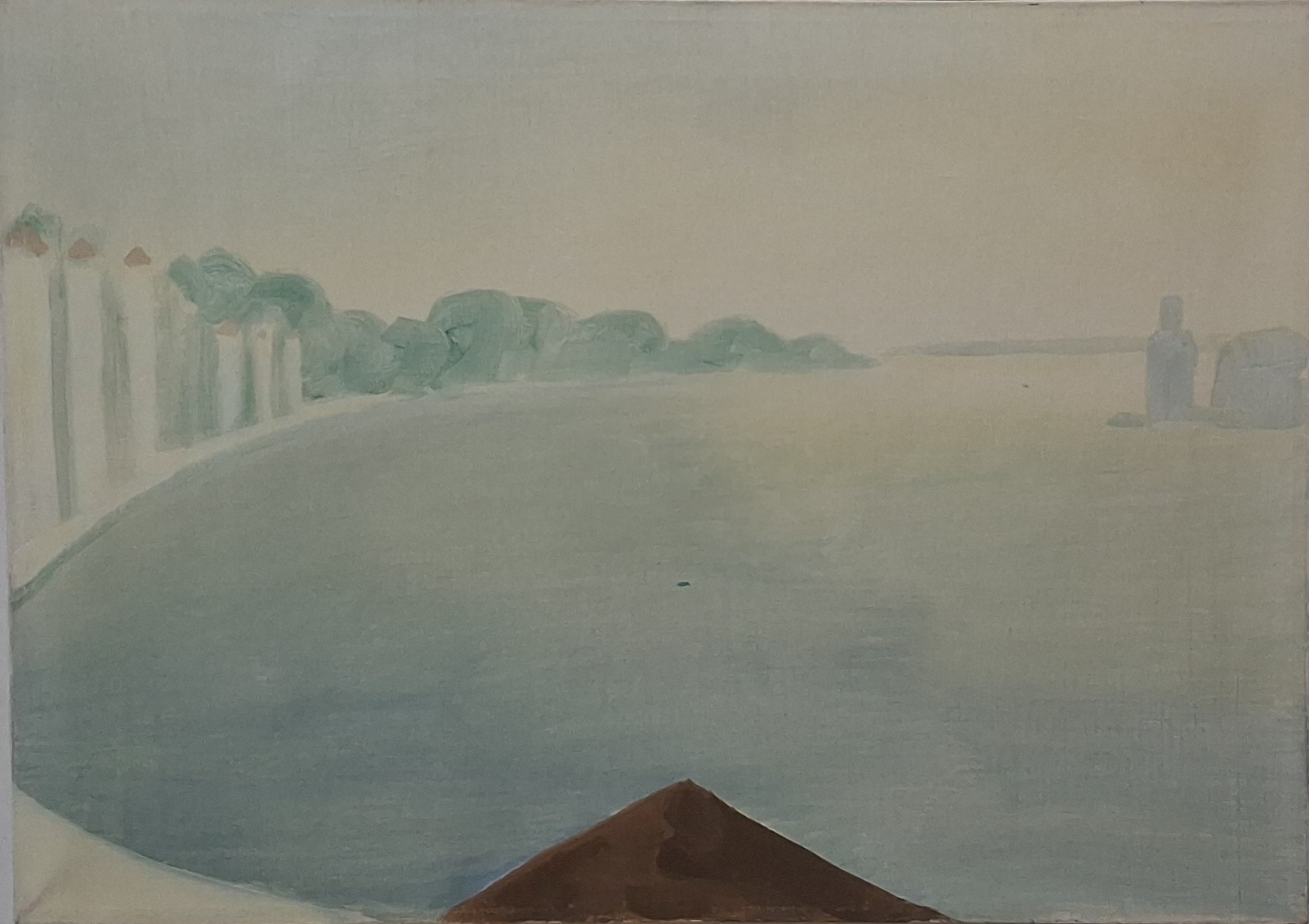
VIRGILIO GUIDI
BIOGRAPHY
Virgilio Guidi (Rome 1891 – Venice 1984). Guidi’s painting style was initially shaped under the guidance of G.A. Sartorio at the Academy of Fine Arts in Rome and subsequently influenced by Spadini, before finally maturing into a fully autonomous style born of reflections on the work of Piero della Francesca and Giotto. The hallmark that places him among the elite of twentieth-century Italian painting is his personal interpretation of the phenomenon of light within space. Known as the “poet of light,” he pursued complex yet coherent lines of inquiry within a figurative style that sometimes borders on abstraction. Light, form, and color constitute—and will remain—an inseparable triad, the only tools capable of expressing a concept of painting that is fundamentally the expression of a clear mental order. The artist began exhibiting in 1915, having been invited to the Roman Secession Exhibition; from then on, he participated in major art events—including the Rome and Venice Biennials, the Rome Quadriennals, and the Lazio Syndicate exhibitions—quickly establishing himself as a key figure in the Italian art world. *Madre che si leva* (Mother Rising, 1921), exhibited at the 1922 Venice Biennale, serves as a definitive reference point for the emerging “Purism” of Donghi and Trombadori, thanks to its solemn evocation of Piero della Francesca—an artist who had recently been championed by the critic Roberto Longhi. In the late 1920s, Guidi left Rome after being appointed to succeed Ettore Tito in the painting chair at the Venice Academy. Particularly significant were his participation in the exhibition “Dieci artisti del Novecento italiano” (Ten Artists of 20th-Century Italy)—organized by Margherita Sarfatti for the 1927 *Amatori e Cultori* exhibition—and his dedicated room at the 2nd Rome Quadriennale in 1935. On the latter occasion, he set forth some important reflections on painting in a written text.